
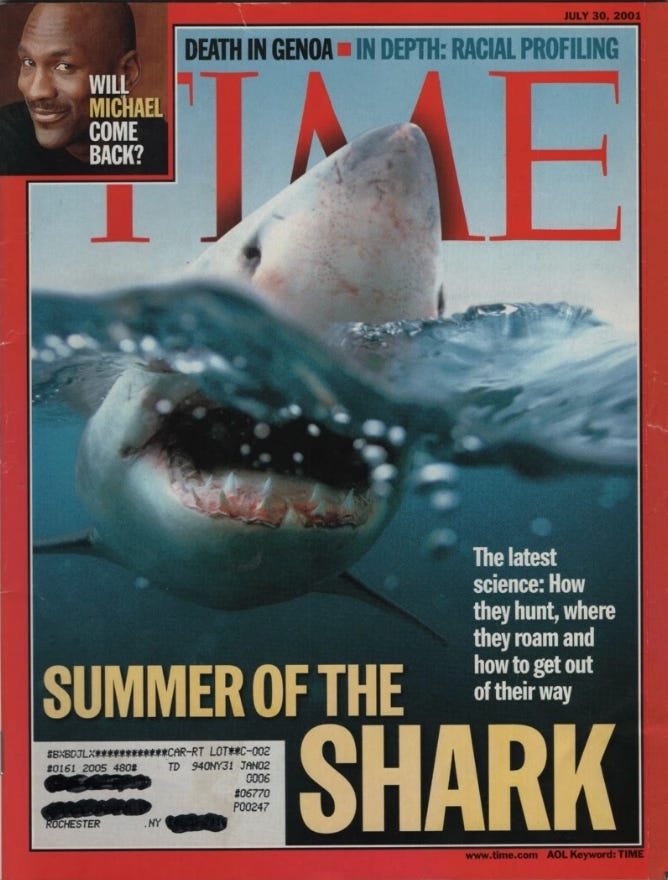
Al-Qaeda probably saved my job at TIME magazine.
“Cost-cutting” had been all the rage as the corporate owners of what remained a profitable magazine were now obsessively focused on boosting their stock price. Profit wasn’t enough for Wall Street; those profits had to grow year on year — hard to do with a news magazine, except by relentlessly cutting costs through annual layoffs. So there I was in the summer of 2001 — ridiculously designated “The Summer of the Shark” by a magazine desperate to tap into America’s fear economy — with a decent track record of writing daily analysis pieces on war and politics in the Middle East, the former Soviet Union, South Asia, Latin America and beyond. But the only thing on my plate that quiet summer was the ethnic Albanian insurgency in North Macedonia. And with the magazine’s interest waning in wars with no U.S. troops at risk, I expected to be listed in the cost-cutting layoff cohort to be named at year’s end.
But Osama bin Laden would supplant the shark to become the premier brand in America’s mass-media manufacture of nightmares. The 9/11 attacks, and the imperial wars of choice they triggered, probably extended the usefulness of my analytical insights to TIME by a further decade.
I had been driving my wife down to her studio in TriBeCa that achingly blue-skied morning when we heard on the news that a plane had crashed in the north tower of the World Trade Center. So we drove down Sullivan Street in SoHo with its perfect view, and got out to join the excited crowd trying to make sense of the almost cartoonish cut-out shape of an aircraft in the façade of that tower. “Hi Mark, I’m going to be in late today. I’m down here at the World Trade Center looking at this plane crash,” I said on my supervisor’s voicemail, via a payphone. “I know we don’t really do local stories, but I figured I’ll hang out and see if I can get some color…” (Nobody had any idea what this plane crash meant in that moment between the two planes.)
Minutes later, a jet-engine roar made us look up as the second plane struck the south tower, and a Jerry Bruckheimer-esque plume of petroleum flame mushroomed out of its façade. Wait, WTF?!! How could two planes crash in the same place… “The President says its terrorism”, an elderly Italian-American woman who’d been watching on TV rasped out of her apartment window to no one and everyone on Sullivan Street that moment.
I didn’t realize it in that moment, but my job was safe, for a while longer – because I knew something about the context.
I had written a number of pieces about Bin Laden and his network following the 1998 bombings of the U.S. embassies in Kenya and Uganda, and then the attack on the U.S.S. Cole in Yemen. Even a “Cocktail Napkin Primer” on Bin Laden (hey, it was TIME magazine) a year before 9/11. And one of my key points in those early pieces was that Al Qaeda was a classic case of what the CIA calls “blowback” – where elements of a proxy operation come back to haunt the agency. In a TIME.com piece posted about ten weeks before 9/11, I’d written:
Bin Laden’s role has always been that of facilitator. That was his function in the ‘Islamist International’ formed, with the active encouragement of the CIA and Egyptian and Saudi intelligence, to recruit volunteers to fight the Soviets in Afghanistan. His considerable wealth (and ability to raise funds from others) and his organizational expertise played a key role in helping the “Arab Afghans,” as the volunteers became known, play a creditable role in the war against the Soviets. And once that war was won, he continued to play the same role, keeping its veterans together and maintaining an infrastructure to arm, train and fund Islamist warriors for deployment in Muslim armies in places as diverse as Bosnia, Chechnya, Western China and the Philippines.
As a U.S. ally in Afghanistan, Bin Laden had been central to organizing Islamist volunteers from all over the world to fight the Soviet invaders. That program, covertly backed and orchestrated by the U.S. as well as Saudi Arabia, Egypt and Pakistan, saw an improbable triumph, as lightly-armed Afghan mujahedeen guerrilla forces, supported by their Arab comrades, eventually forced the withdrawal of the world’s largest conventional army. Now, though, his battle hardened international brigade had no way home, and would turn its attention to other powers occupying or intervening in Muslim lands. And by 1991, that meant the U.S. itself.
Bin Laden believed America could be beaten. His objective, of course, had never been conquer the U.S. but rather to end its presence and pervasive influence in the lands of Islam. Exhibit A for his optimism was the U.S. withdrawal from Beirut in 1985, after what became Hizballah blew up a Marine barracks there killing some 240 U.S. troops. The bloody carnage of Mogadishu in 1993, in which 17 U.S. soldiers were killed in an abortive raid on a local warlord, also led to a hasty retreat [EM] today U.S. officials believe operatives linked with bin Laden helped train the Somali gunmen who ambushed the Americans. And in his propaganda, bin Laden certainly claimed the incident as further proof of his basic thesis — that the U.S. would withdraw from Muslim countries if the cost of staying was rendered too high.
The 9/11 attacks on U.S. soil were intended to raise the cost of remaining in the Middle East. The Blowback had come home.
A second dimension noted in that pre-9/11 TIME piece was also worth noting: “In the language of advertising, Bin Laden has become a brand — a geopolitical Keyser Soze, an omnipresent menace whose very name invokes perils far beyond his capability.”
Terrorism as mass communication
The language of advertising is extremely relevant, here, because terrorism — the tactic of using military violence against a civilian population in order to send a political message to amplify a cause, to pressure political authorities to change course, or provoke an ultimately self-destructive response — is not a form of warfare. It does nothing to degrade an adversary’s forces in the field or ability to wage war, nor to contest control over any piece of territory. Terrorism is a brutal form of political communication, known in the literature as “propaganda of the deed”.
Some years later, in 2010, I had an opportunity to explain the concept to the TIME.com readership by analogy. That was when Pastor Terry Jones, a complete nobody in the Islamophobic Evangelical world — his entire congregation could fit into a single school bus — made himself an international celebrity and the target of thousands of protestors across the globe, even a warning from the Pentagon that he was endangering U.S. troops. How? He had staged a backyard Koran-burning for TV cameras. Like Terry Jones, Bin Laden understood how “propaganda of the deed” functioned in a society of the spectacle.
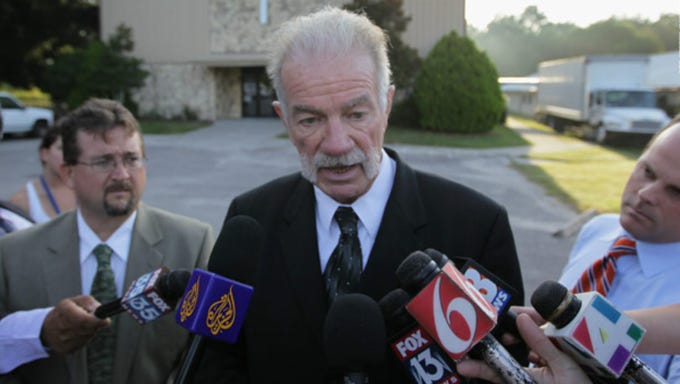
Despite his delusions of grandeur, Bin Laden had been a marginal figure, even in the realms of political Islam. But…
…When al-Qaeda attacked the U.S. embassies in Kenya and Tanzania in 1998, people began to take notice — especially when President Clinton responded with a panicky fusillade of cruise missiles aimed in bin Laden’s general direction. But that was nothing compared with the epic notoriety the al-Qaeda leader would earn when 19 of his men in hijacked airliners brought down the World Trade Center and trashed the Pentagon on Sept. 11, 2001, killing almost 3,000 Americans on home soil.
Suddenly, bin Laden and his little band became the living incarnation of America’s worst nightmare — the President of the United States literally declared war on him, although he commanded no divisions, held no territory and had precious few visible assets. The al-Qaeda leader dominated the U.S. national-security conversation for years after those attacks, even though his movement never came close to matching its grotesque feats of 9/11 again.
Terrorism’s basic device is “propaganda of the deed” — a marginal group of extremists can briefly overcome its deficiencies in real power and presence through spectacular acts of violence that draw the public’s attention, enabling the group to air its grievances and build its “brand.” That’s how bin Laden managed to convince Americans, although not the overwhelming majority of the world’s Muslims, that he was the leader of a global Islamist rebellion.
In this framework, the terror “deed” — via its amplification by mass media — forces the perpetrators and their cause into public consciousness at massively outsize scale. Although it kills or permanently scars many civilians, the act of terror is first and foremost a disruptive media intervention. As the live TV images of the World Trade Center attacks beamed into homes across the country, four out of ten Americans stayed home from their jobs that day. And the endless TV replays of the images of the World Trade Center being struck delivered on the goals of the perpetrators beyond their wildest expectations; they traumatized millions of Americans, manufacturing an illusion that they all faced an existential peril, every day, everywhere.
The biggest immediate beneficiaries were imperial and authoritarian forces in Washington, who took the climate of fear as an opportunity to violate domestic and international law at will – launch disastrous wars, torture captives, put their population under mass surveillance and more.
Israel was another major beneficiary: Then-foreign minister Benjamin Netanyahu chortled the next day that the 9/11 attacks were “a good thing”, because they cemented in the U.S. mind the narrative of an “Islamic terror threat” that bound it ever closer to his settler-colonial apartheid regime. The U.S. “war on terror” (an absurd formulation, of course) effectively ended any U.S. pressure on Israel to complete the Oslo process. And less than a week after the attacks Netanyahu was on Capitol Hill, urging the U.S. to attack not only Afghanistan, but also Iran, Iraq, Syria, Libya and Sudan.
Despite its success on 9/11, Al-Qaeda remained a small network of a few hundred men, hardly a serious military threat to the U.S. When running for President in 2004, Senator John Kerry – mindful that one of the key metrics of success of a terror attack is the self-destructive response it provokes from its target authority – was ridiculed by the Bush Administration for pointing out that terrorism was essentially a law-enforcement and intelligence challenge rather than an existential national threat. “We have to get back to the place we were, where terrorists are not the focus of our lives, but they’re a nuisance,” Kerry said. “[Al-Qaeda] isn’t threatening people’s lives every day, and fundamentally, it’s something that you continue to fight, but it’s not threatening the fabric of your life.”
Such sobriety didn’t resonate with mainstream America, not least because of its mass media. The “Summer of the Shark” TIME cover had been a shallow and cynical attempt to capture Americans’ attention by invoking a phantom menace. But the specter of Osama bin Laden, manifested in the trope of those airliners hitting the World Trade Center, was a gift that kept on giving. Bin Laden’s image featured on at least 11 TIME covers — Hitler had only made it onto 6. The “Summer of the Shark” had morphed into the Decade of Al-Qaeda.
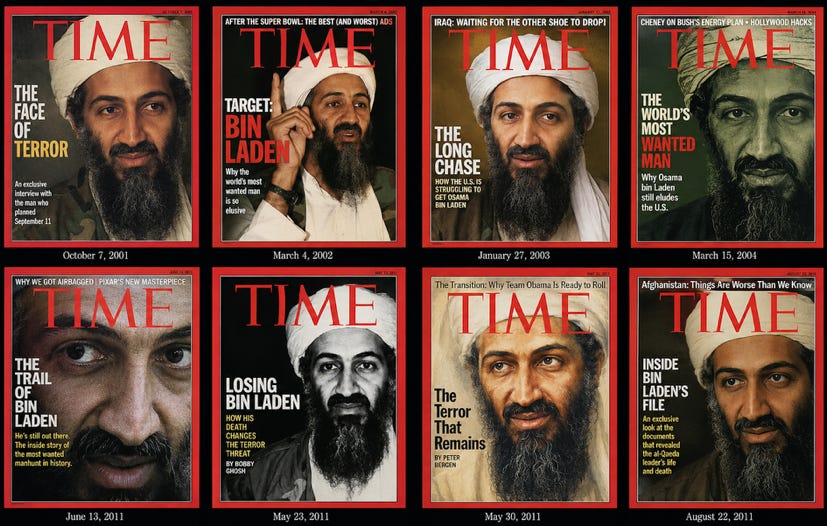
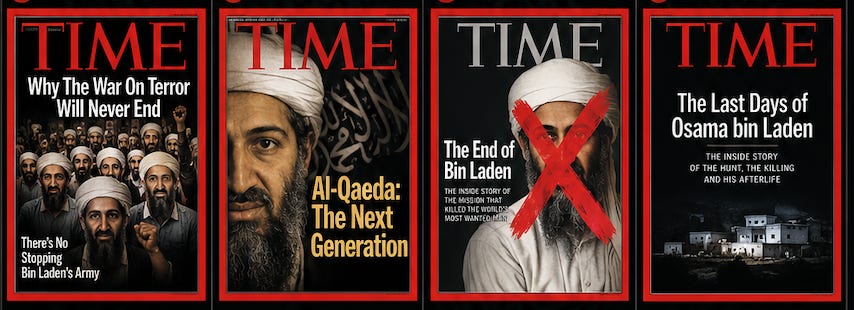
Al Qaeda’s “gift” was not only to the U.S. news industry, which made Bin Laden the resident monster-under-the-bed of the mainstream American nightmare — a role that had been vacant since the collapse of the Soviet Union. It also represented a unique opportunity for an alliance of U.S. arms-industry lobbyists and neoconservative ideologues who had for years been itching for an opportunity to use U.S. military force to remake the Middle East on U.S. and Israeli terms. (And, yes, it kept some of us who knew a bit about Al Qaeda and about the countries the U.S. invaded in response to the 9/11 attacks gainfully employed…)
Defense Secretary Don Rumsfeld was famously quoted as urging, in a meeting the next day, that the U.S. response include attacking Saddam Hussein’s regime in Iraq, which had no connection with the Al Qaeda strikes “Go massive,” he instructed U.S. intel officials. “Sweep it all up. Things related and not.”
Rumsfeld and his fellow hawks knew the psychological impact of the 9/11 attacks would create public consent and bipartisan support for new imperial military expeditions in the name of protecting Americans from a phantom menace made plausible in the minds of millions. The fear of attack engendered by 9/11 allowed President George W. Bush to attack Iraq with public support, telling Americans they faced a nuclear attack from Saddam Hussein). Decades later, President Trump — who came to power castigating Bush for sending Americans to die in a war based on lies, told Americans to believe he was attacking Iran to protect them from a nuclear strike.
Even today, the (generationally) fading specter of 9/11 that had mainstreamed Islamophobia is being desperately revived as a centerpiece of campaigning by Republicans (and arguably even establishment Democrats) against Mayor Zohran Mamdani, senate candidate Abdul Al-Sayed and other politically progressive Muslims.
In the end, the greatest consequence of the 9/11 terror spectacle was the damage it allowed America’s leaders to do to Americans, and to the millions elsewhere whose lives have been destroyed in the wars that claimed “war on terror” justification. The legacy of wars and repression triggered have made America less safe, less free and more globally isolated and resented than at any point in its history.
Those were the days, Tony. Thanks for always keeping your eye on the ball.
Pretty decent HR manager to be fair.